Sunday, 2 March 2014
28 Days to go. Please Sign Barnet UNISON's 'Gagging Petition'
Please sign our petition here: https://you.38degrees.org.uk/petitions/stop-gagging-local-unions-in-barnet-council

Defending Barnet UNISON - a priority for every trade unionist

Prof Ewing focused on the Blacklist in the construction industry, which I've mentioned before on this blog.
However, there are two trade unionists whose names everybody in UNISON should know: John Burgess and Helen Davies, the Branch Secretary and Chair of Barnet Local Government UNISON branch, who have been the driving force behind their inspirational campaign to stop the privatisation of their local public services.
On 1st April they're being evicted from their trade union office and their facility time is being cut to zero by the Tory borough.
We should all be familiar with blatant and sometimes illegal attacks on trade unionists (such as the blacklist in the construction industry) - and I've covered another example here recently, the sacking of Charlotte Monroe.
Barnet council have shown there is 'more than one way to skin a cat' - if you don't think you can get away with de recognition of a trade union, or the more blunt option of sacking a rep - they've decided to go for their agreed facility time.
This is a de facto de-recognition, making it impossible for John and Helen and their branch Committee to function properly as reps.
Rather than bury our heads in the sand, hoping it will go away (and thankful that's not happening to your branch), every trade unionist and every part of the biggest public trade union in the country should be up in arms about this.
Sign their petition, share it, and ask your regional reps - what are you doing to stop what is happening in Barnet?
We have less than a month to stop this: It is the thin end of the wedge.
Get in touch and find out how you can help, how you can support them.
John had been promised a new report (photo) by the Institute of Employment Rights (IER) - Keith Ewing is their President. The first thing I'll be doing on Monday morning is posting it to their branch first class. By the way, I have a couple of spares left if you want one.
What else can we do?
Keith Ewing said we should demand from our councils that they don't give public sector contracts to companies who use blacklists (and the same should apply to Universities). We should be saying:
"If you are going to blacklist us we're going to blacklist you!"Keith Ewing also called on three things we should demand from a Labour Government:
- We want laws to stop black listing forever
- We want a law to stop victimizing trade unionists
- We should be demanding the restoration of trade union facility time
If you still have a facilities agreement and some money in the bank (more on that later) we should all affiliate to the Institute of Employment Rights, and get their reports sent direct to you office. That is, whilst you still have an office to send it to ... because that is more than Helen and John will have if we them get away with it.
Saturday, 1 March 2014
Resistance to pay freeze continues? UNISON conference votes for further consultation #UNHE14
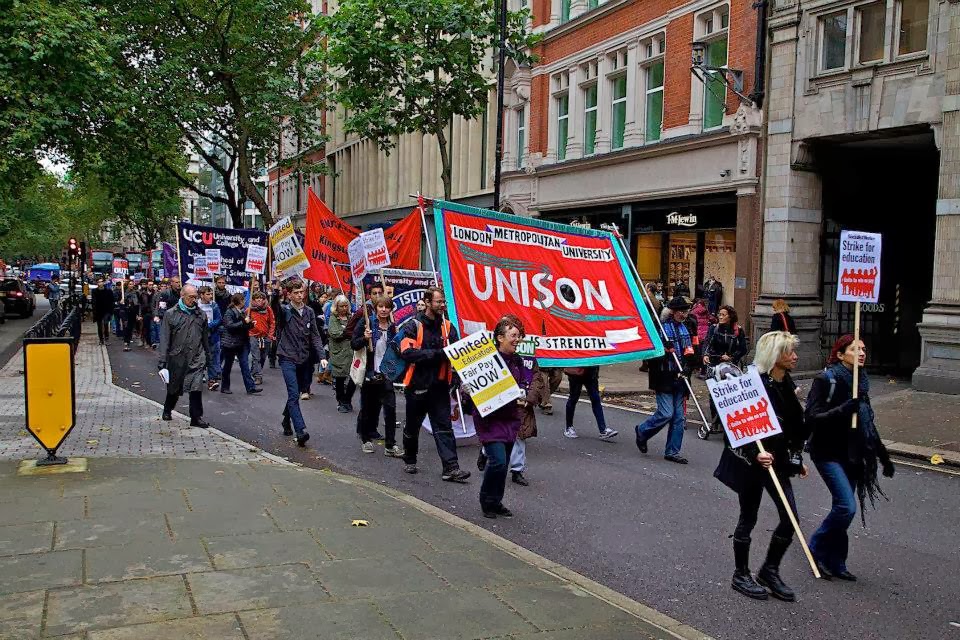
This nonsense immediately brought back memories of two years ago when the same SOC ruled out all five emergency motions on pensions in the middle of our dispute, and the then President, lost control of conference by patronising delegates and backing up the SOC, leading to utter chaos.
This year was completely different though; we had a healthy debate on our pay dispute and spent over an hour debating the key issue at a delegate-based conference - the way it should be.
How? Firstly, delegates led by Lucinder Wakefield of Sheffield Hallam, articulated brilliantly the need to 'refer back' the SOC report and seek to change the order of business. That vote was overwhelming. Then came the surprise: the Vice-President (with the backing of NEC members present) actually overruled the SOC when they refused to bring the debate on pay forward, as was the will of conference.
Instead of booing and heckling the President, delegates gave her a standing ovation at the end of the conference for allowing conference to discuss the top issue of the day: Pay.
So where next on pay?
So what did conference decide we should do? There were three options broadly, and none of the options called for an end to the dispute.
1) Cool things off - a 'time to reflect'
One option was to cool things off for a bit - no more strike action until a consultation with membership on what action next which will inform our next steps. The exec group backed this position expressed in Emergency Motion 1, and conference narrowly agreed. The room was divided and the vote was very close in favour (the vote was taken twice). Whilst Emergency Motion 1 was clearly carried and this meant all others fell, quite a few delegates called for a card vote and if this had gone ahead, who knows which way it would have gone due to a large variation in branch sizes.
Whilst I'm bound to collective responsibility, it would be strange if I had not supported the second option:
2) Develop our strategy to win
Emergency Motion 6 was submitted by London Metropolitan University and called for developing a strategy to win: for exploring further coordination of strike action with other unions in dispute, exploring 26th March with the NUT as an option as well as referring to the Local Government pay dispute; a supplementary ballot for action short of a strike (ASOS); and for rolling the dispute into next year's pay claim.
This was a result of a debate in our branch and after I'd heard from a few others in London calling for other action in addition to strike action (like ASOS). I might have disagreed with part of this but tactically I think it's helpful to equip ourselves with all options going forward.
3) Call for a strike on 26th March, with the NUT
Another motion from Manchester Met called for making immediate preparations for taking strike action on the same day as school teachers in the NUT on the 26th March. This position received the most support from the left, but fell after EM1 was passed.
Left unity
Left activists had met the night before and had an excellent discussion on how to move forward and learn the lessons of our struggle over the last few months. I think we should be enormously proud of ourselves for continuing our dispute and putting up a brave fight against a recalcitrant employers' association and viscous government determined to hold down public sector pay, and also against sometimes reluctant and plodding elements who have done everything in their power to undermine our dispute.
We on the left shared our experiences with Students who have fought privatisation at Sussex: Adriano Mérola Marotta, one of the victimised 'Sussex five' students spoke; and Trish McManus from the UCU shared their experiences facing similar hurdles as we have in UNISON. The ties and bonds between us over the last few months has been strengthened - and the UCU Left meeting today is a great chance for UNISON reps to get together and solidify those relationships.
Is there still a mood for more action?
One delegate from Middlesex branch neatly summarized the position which won the day: "We're not saying we should end the strike action, just that we should wait until members have been fully consulted." What was interesting was only two days before, at the London regional AGM, we heard a report from the very same Middlesex branch Chair that their members had just been consulted and had indeed voted for more action. The delegate must have run out of time before he mentioned that...
Many UNISON branches still have their AGMs coming up - this is a perfect opportunity to sound out members for what action they're prepared to take but also to show some leadership, not passively ask closed questions. The more members coming together to discuss how we can take our dispute forward and into the next round of talks the better. The question asked is important: for us in London Met branch Committee we discussed not "if" we should take more action to win the dispute, but "what" should the next steps be - what kind of action we should take to further our aims.
We discussed two hour strikes, walks outs, action short of a strike (working to rule), and more. We need to get creative, get mobilising members again. And yes, we need to talk about hooking up with other unions in dispute, not just the UCU but also the NUT, NAPO, FBU or others. To be sure: we need to strengthen the confidence in our own members' and stop playing down the impact of our strikes. The mood from the conference shows we're not far off the mark.
Leadership
One delegate spoke against calling for strike action on 26th March and for opening consultation: "The trouble with leading, is that if no-one is with you, you are essentially just out for a walk." That may be the case, but at least when you are walking you are moving in any direction. The trouble with standing still, or pausing whilst you 'reflect', is you're not going anywhere.
This is the crux of the matter. We must believe we can win, show leadership, bravery and honesty in our ability to change the mood from pessimism to optimism. We must actively engage in this consultation and win the members back to believing we have a strategy to win against a divided employer. It mustn't just be a passive consultation whilst reps all go back to the daily grind of case work, secretly glad that's all over with.
Increased strength, new reps and first-time speakers
One delegate from LSE talked passionately about a surge in membership in his branch once they began to take action. Suddenly their union was visibly doing something significant for their members again - another rep from Queen Mary had said the same in London AGM. This is the case across the sector - we had a massive spike in membership during our dispute. We also saw quite a few new faces and first time speakers at conference - particularly women.
Another rep from Bath talked about the new activity there for well supported strikes. David Summers, our delegate from London Met described travelling for over two hours across London during the RMT strike to get to a strike rally at Tower Building on 6th Feb. The dedication and commitment of our activists to this immense struggle has been exemplary and should be commended not downplayed.
We've held our line remarkably well in places - and this is in stark contrast to two identical emergency motions which belittled our strikes and talked down the strength of our union. Thankfully it was not passed by conference as it was a most unhelpful motion.
There is obviously a difference in experience, and as one delegate who was in favour of the 'Time to reflect' motion, said: "The speakers against our motion are the passion and the lifeblood of our union....but...."
Huge achievements so far
We have put up a huge struggle so far and we should be proud to have come this far. We have shown the employers, who did not think we would put up such a fight, that we mean business. They have down played the action and yet would love for us to call off further action.
There were many who didn't believe we would get a ballot, nor win a yes vote for action at all. Some branches who voted for further consultation this year didn't engage in the consultation before the ballot last year (therefore bringing down the turn-out), and then they complained that we didn't have a mandate to strike with such a low turn out!
Some didn't believe we could pull off the first day of action nor the second and they were proven wrong every time. Some even tried to get the HE SGE to call off the third day altogether when we had already taken a democratic decision to call that day of action and build for two months before, on 6th December.
Since the dispute began, several Universities have relented and agreed to back the Living wage. Others have shown their colours by giving their staff a one-off bonus at Christmas time last year. Higher Ed branches have grown in confidence where previously they've had little activity. The employers will be thinking very carefully about what they offer us next year and are suddenly are inviting us to 'exploratory talks'.
So we've faced an up-hill struggle to get where we are. I believe the employers will be adamant that we call off further action before a new round of talks and this is evidence of our impact. Our heads should be held high - not matter what happens in the near future we've given them all a good run for their money.
And the left have played a key role in all this; we've worked well together when it counts; remained comradely whilst some others are seemingly obsessed with fighting among themselves; we've strengthened our reach and are in a good position to build for the next phase.
Going forward
As well as March 26th NUT strike, we should also keep a close eye on three things, two local disputes and one national:
1) First, the SOAS UNISON dispute: two days of strike action are planned 4th and 5th March by cleaners calling for equal terms and conditions as in house staff. Victory there would be an inspiration for our whole sector.
2) Second, the Birmingham Uni UNISON dispute where they look like they're on the cusp of a significant win on local pay talks after taking two days strike action and threatening escalation.
3) Perhaps more importantly, the consultation in UNISON's local government Service Group. If the largest local bargaining unit in the country moves towards a ballot (as they appear to be), this will change the balance of things quickly.
All three will frame the confidence of our union as a whole as well as the HE sector. Judging from conference, and if we pro-actively engage in the new consultation, my prediction is this fight ain't over yet.
Tuesday, 25 February 2014
UNISON HE LEFT FRINGE MEETING
WHAT NEXT FOR THE HIGHER EDUCATION PAY
DISPUTE?
Come
along for the discussion about where to go next in the fight for fair pay in
higher education, what should UNISON’s strategy be? There will be UNISON, UCU
and student speakers and time for everyone to ask questions and debate.
Wednesday 26th February at
7pm
Club 10 Below
(Underneath The Smugglers Pub on Ship
street)

For
anyone who would like to stay on for a drink there is a bar and there will
be a social afterwardsJ
Tuesday, 18 February 2014
STOP GAGGING LOCAL UNIONS IN BARNET COUNCIL
TO: RICHARD CORNELIUS LEADER OF BARNET COUNCIL
Dear Mr Cornelius It is clear from your own website that Barnet Council has already embarked on a radical outsourcing policy which has had a significant impact on former and current Council workers. Surely you must recognise the importance for staff to be represented and supported by a trade union? Facility Time is good practice and is a means by which trade unions can carry out what are often demanding and complex roles which includes provision of advice to members, formal representation of members in grievance and disciplinary hearings and negotiating with managers over terms and conditions, outsourcing, restructures, cuts to services.
Read the rest and sign the petition here: https://you.38degrees.org.uk/petitions/stop-gagging-local- unions-in-barnet-council
Saturday, 8 February 2014
Monday, 27 January 2014
Reinstate Charlotte Monro!
This is Charlotte's speech to the rally held outside the London hospital on December 4th 2013.
In her contribution Charlotte elaborates the background events leading up to her sacking, puts this in the perspective of the current all-round onslaught on the NHS as a whole and calls on the health workers and the community to step up the work to defend and safeguard the future of the NHS.
http://www.savelewishamhospital.com/reinstate-charlotte-monro/
BBC news report for background:
http://www.savelewishamhospital.com/reinstate-charlotte-monro/
BBC news report for background:
Subscribe to:
Posts (Atom)